The following posts are from a website originally called SF in Paris, a blog about a jet-lagged family trading known complexities in San Francisco for unknown ordeals in Paris
Our travel schedule
Forthwith, our plans, lofty and misguided though they may be:
| Dates | Plans |
|---|---|
| May 30 – Jun 4 | First stop – Paris! Dump our ski gear and excess baggage, attempt to secure an elusive Parisian rental unit |
| Jun 4 – 18 | Sicily. Sunglasses in hand, we decamp for the land of sunshine and wine. |
| Jun 19 – 24 | Italy by train and car. Travel from Rome to Tuscany. |
| Jun 25 – Jul 9 | Tuscany. Taste wine, eat, repeat. |
| Jul 10 – 12 | Venice. Another opportunity for open water swimming? |
| Jul 13 – 17 | Switzerland + untethered travel! |
| Jul 18 – 28 | Zurich, Innsbruck, Salzburg, Prien, Munchen |
| Jul 29-30 | Legoland Gunzburg, Germany |
| Jul 31 – Aug 6 | Hamburg, Germany (visit friends) |
| Aug 7 – 13 | Hamburg, Germany (visit relatives) |
| Aug 14 – 21 | Holland (visit Oma) |
| Aug 22 | Back in Paris, now with even more desperation to get a roof over our heads |
| September ’05 – July ’06 | Entrepreneur in residence at INSEAD business school, occasional guest lecturer at Oxford Said School of Business, connaisseur of croissants and open air markets |
Faux FAQ
Answers to Questions that would be Frequently Asked If Anyone Actually Cared (Which, Just For The Sake Of Clarity, They Almost Certainly Do Not)
Q: Is this going to be another rambling, self-aggrandizing exercises in pretending that there is a greater significance in your existence and activities than is strictly warranted under the circumstances? A: Yes
Q: What is this blog “about”? A: Nominally, a one year sabbatical following a San Francisco family of four as they wend their way to Paris and what happens there. The cast includes a guitar-playing, recovering entrepreneur, rehabilitating himself by recapitulating his many business sins to impressionable etudients at INSEAD; a hard-skiing, recovering Accenture assoc. partner-cum-mom rehabilitating herself by becoming a French wine expert; plus two mono-lingual male progeny, post diapers, pre-teen terrors.
Q: Why are you writing this? A: Blogs are a simultaneous exercise in laziness and self-deceit. Laziness, because if I had something truly interesting to say, I would take the time to write it down well enough to get it published. Self-deceit, because despite the fact that I have not taken the time to either think of something truly interesting or to express it well in writing, I still cherish the illusion that someone will care to read it. Also, our parents want pictures of the grandkids.
Q: What warranties, limited and otherwise, are you prepared to make to your readers? A: I solemnly vow and aver, that I will use reasonable commercial efforts to make this blog entertaining, provided you have a sense of humor in a permanently arrested state of development circa Animal House and This is Spinal Tap.
Q: What is wrong with everyone? A: Loss of context, of identification with shared goals and common goods. Increasing fragmentation into mutually hostile factions with no interest or even language for finding the shrinking middle ground. “Things fall apart, the center cannot hold, mere anarchy is loosed upon the world.” One of many symptoms of this loss of context is the widespread desire to create a purely personal context and share it with total strangers as an examplar of the “right” way to think about things – otherwise known as a blog.
Q: What are your influences? A: Well, let’s see. Bach, definitely (Ich Habe Genug, Goldberg variations), then the bible (psalms, John), Kierkegaard (Fear and Trembling), Yeats (The Magi), Melville, Ian Tyson (Four Strong Winds), Emmylou Harris (Red Dirt Girl). Also, more humblingly, The Partridge Family (first album bought with my own money), that awful Mark Spitz Olympic medal swimming poster (also the Farah Fawcette one if the full truth must be disclosed), pretty much any trashy science fiction novel and Hellspawn comic books. 05/24/05
Our wants are few, our demands are simple
What we want from our European adventure:
- Recapture the still spaces in our lives lost to the twin demons of activity and anxiety
- Rebuild the common spaces between our lives which have been made barren by overgrazing and underwatering. Much of the goodwill in our relationship has been overgrazed through the profound inequalities between a work-bound husband and a house-bound wife. The sources of goodwill in our relationship have been underwatered through too few shared joyful experiences.
- Restore us from our diminished state, beaten down by countless small indignities, numberless small ethical accommodations, myriad small rages.
In short, we want to remember how to dream, both for our own lives and for our lives together. 05/26/05
Drinking the best wine first
It has long been our philosophy to find a wine we like, buy a case and drink it immediately. There is something twice sad about cellaring wine – first, the delayed pleasure of turning grapes into wine; and second, the deferred pleasure of letting the wine gather dust and (usually) lose flavor moldering away in some sad corner of the house.
Despite this, we occasionally acquired bottles of fine wine that seemed too good for the times we were living in. So we tucked it away for the right occasion, which of course never came. Before leaving for Europe, however, we determined to drink every single bottle of wine in our house before we left. Given the number of social functions that filled our final weeks, this was not as difficult to accomplish as you might imagine.
The findings from these experiments in forced consumption were as follows:
Approximately 1 out of 5 bottles that we had cellared for 10 years or more tasted better than we thought it would. The rest tasted worse (usually substantially worse), confirming our basic wine acquisition prejudices (this is in keeping with one of the most basic tenets of science, the “law of least surprise,” that the purpose of an experiment is to confirm existing prejudices – see Occam’s Razor).
Forget admonitions to “die broke.” Our new life objective is to die with an empty cellar. 05/29/05
International airport lounge as catalyst for whirled peas
The world could be a much better place if all political negotiations were conducted in international departure lounges. All of humanities good traits are on display – families and friends congregate together quietly with the genuine goodwill that only occurs when people know they don’t have to keep it up for too long.
The international departure lounge occupies a unique geographical space – it is not “here,” nor is it there – it is simply a transit point. As such, it is the only place in the world where everyone feels at home, precisely because it is nobody’s home. Lavish costumes get no special attention, mixed race couples get no sidelong glances, local taboos are suspended.
Bringing this to an immediate practical point, where in the world can a western politician enter into a serious dialogue with a turbaned and whiskered counterpart without activating a complex web of prejudices? Likewise, where can a middle-eastern politician regard his western counterpart without conjuring a whole lifetime of oppressing demons?
I say let them meet one another in any international airport lounge, surrounded by family members of all ages. Freed of the politics of place and held in the eyes of familial love and respect, how could the results fail to be a marked improvement on the politics of today? 05/30/05
Kids and travel – don’t forget handi-wipes
“Parents need to let their kids explore so that they can find new places. If parents don’t follow their kids, they won’t find new places.” — my youngest child, age 5
The highlight of our first day in Paris was when the kids got stuck in the elevator. In a city where no building is used for the purpose it was originally intended, elevators are improvised affairs and can be prone to sudden work stoppages, just like the rest of Paris.
After 15 minutes, we got the doors open and could pass provisions through a narrow opening. For the next hour, the boys gorged themselves on bonbons, played gameboy and read comic books. Their greatest disappointment was that their rescuer was not a fireman in an exotic uniform, but a plainly-dressed elevator repairman.
At breakfast the next day, my child complained that the milk tasted funny (in fact, because it hasn’t been pasteurized, it actually has taste). Shortly thereafter, we got on the subway to visit an apartment we hoped to rent. During the trip, the same child decorated our subway car and a good part of the station with the colorful remains of his breakfast.
Following an emergency stop at the pharmacy for handi-wipes, we raced to the apartment, fragrant but determined. We hit it off with the landlord, who stayed well upwind of my youngest child during the interview. We ended up renting the apartment, a beautiful but very small 2-bedroom place near metro La Muette in the 16th arrondisement.
Despite, or maybe because of these adventures, my children are having the time of their lives. They don’t really walk anywhere: they flit, they skip, they leap to the next adventure.
“Dad, I really like all this new stuff. San Francisco was getting a little boring.” — my older son, age 8 06/02/05
The score after 1 week – crepes: 47; museums: 0
Trying to find a good bistro in St Germain is very much like trying to find good seafood at Fisherman’s Wharf in San Francisco. There is some sort of diabolical principal at work in the world’s great tourist areas that situates the worst restaurants exactly where the most people are trying to find something to eat.
Although the steak frites in St. Germain were a complete write-off, we found that the crepes are heavenly. We therefore determined never to go more than a few blocks at a time without refortifying ourselves with a crepe au sucre.
All the famous places were mobbed and all the parks were pleasant, so we stuck to the open spaces and avoided anything culturally edifying. We have a whole year to educate ourselves but only a week to convince our boys that this vast dislocation was a good idea.
At the Eiffel Tower and the marvelous play structures of the Parc Luxembourg, the boys gained a healthy respect for French engineering. At a beautiful outdoor restaurant near the pont neuf they played until 11 pm with the owner’s son (who spoke no English).
After a week in Paris, my older son had not darkened the door of a single museum or church. I felt that I had done my parental duty, however, in that my older son became enough of a connoisseur to formulate a simple way to judge crepe vendors, “dad, the best crepes have more sugar and cost less.” 06/04/05
France Hotel Review – Paris, Left Bank St Germain
Hotel Left Bank St Germain — paris-hotels-charm.com
- Location: Very near Odeon subway stop, in the middle of all the hubbub, if that is what you like
- Room (2 adults, 2 children < 10): We had a nice but small room that barely fit two queen beds and was quiet. We found it was very difficult to find rooms for a family of 4 in Paris, so we were thankful to have someplace take us in.
- Service: Good, but Parisian if you know what I mean. The quality of service depended greatly on who was sitting at the front desk.
- Internet: No
- Food: Breakfast was included, but just ok – don’t expect world class croissants and cheese here.
- Best feature: Location
- Best food nearby: There is a lot of really, really bad food in the St Germain area. We didn’t have any good meal in the area.
- Price: 250 euros a night (June)
- Overall family rating: OK — 6 out of 10. We looked hard to find a good family hotel in Paris near St Germain. Maybe this is the best you can do in this price range. Still, I think you can do better. 06/05/05
Watch for the little man in the donkey cart
Driving to our villa in Sicily, semi-lost along a deserted road, we came upon a man out for an evening stroll with his friend. He was driving a small donkey cart and his friend was in an equally small car, chugging alongside the cart.
As the two of them blocked the road, we had no choice but to meander behind them for a mile or so.
Being forced to stop hurrying through the countryside and look around made this the most enjoyable part of our journey.
Every time we go for a drive now, the boys compete to look for the next “little man in a donkey cart.” 06/06/05
A mail-order villa of dreams
Renting a villa after perusing a few pictures on the internet carries with it many of the same risks as mail-order brides. The less concrete knowledge you have of what you are getting into, the more unrealistic your expectations.
Remarkably, what we found on arriving in Sicily was a villa of dreams, full of tiled floors, arched ceilings and covered with grape vines. It looks like it was built in the 1600s but was actually built in 1969, which means that it has lots of romance AND the plumbing works.
The villa sits near the town of Trecastagni on the slopes of Mount Etna. It has a small pool, where we plant ourselves on sunny days, and an airy kitchen where we cook most of our meals. The roads around the villa are full of farmers selling fresh fruit and vegetables, and the towns have a wealth of small shops selling local specialties like a country salami, pecorino cheese and local olives. 06/08/05
Feeding kids in Sicily
Dinners in Sicily are a problem, as the restaurants open at 9pm, well after bedtime for our boys. The only place to get a bite earlier is in the take-out pizzerias – but these can be hard to find, as the good ones are located away from the high rent town center.
My friend the fruit stand guy told me about a great pizzeria, owned by the father of his helper (it’s a small town). He took pity on us after watching us trek around the town square to three restaurants at 8:30 pm, none of which were open.
We miraculously understood enough of his directions to find our way to a tiny pizzeria well outside of town. Inside was a big oven made of lava rocks with a roaring fire that cooked both the pizza and the people in the restaurant, and a number of sweating Italian families. Nobody waited longer than necessary to get their pizza box, pay and run back home to feast on thin, crisp pizzas filled with flavors that grew right around the corner. 06/12/05
Amalfi or else
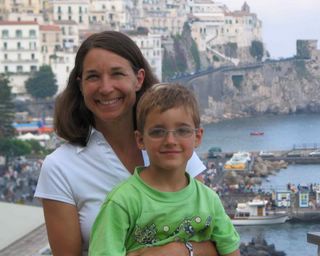
Driving from Sicily up to Rome, we toured the rugged Amalfi coast. We stopped at the town of Amalfi when my younger child declared that he would throw up if we took him around one more curve.
The city of Amalfi is an old fishing village built up a steep ravine, on top of a buried river that you hear rushing under your feet as you climb through town. The town has two stoplights, one at either end of the ravine. They regulate the traffic on the narrow street by sending it in one direction for five minutes then reversing the flow for five minutes.
The only flat place in town is a small square near the marina, which is where all the local kids go to play at night. My older son tried out his soccer skills with the local kids while we talked to their parents and the rest of the town did laps promenading along the marina. 06/22/05
Travelers as modern hunter-gatherers
One of the great joys of travel is finding out how well just winging it works out. Looking back on just one month of travel, all the really magical experiences happened by accident.
Thousands of years ago, our hunter-gatherer ancestors may have experienced the miracle of provenance on a daily basis. To experience this now, we have to get far enough from our tightly scripted lives that we can let serendipity take over.
A certain amount of planning is required to get to a spot, this is true. Yet once there, plenty of slack in the schedule is required for anything interesting to happen.
We expend tremendous energies convincing ourselves that the more minutely we plan our destinies, the better they turn out. Travel proves just the opposite, that the more tightly we plan, the more surely we will miss the essence of a place. 06/23/05
That can-do American attitude
At forty kilometers away from Rome, we had exhausted every hotel suggestion our tour book had without finding a single vacancy for a family of four. It turns out that there are some cities where a bit of advance planning is useful.
In an act of desperation, I pulled out my American Express card and called their 800 number. The next minute, an enthusiastic Texas twang blasted in my ear, “hi, my name is Randy, how can I help you?”
Within 5 minutes, Randy had us booked into one of the hotels that had just turned us away, no fuss, no muss, no bother. As wonderful as Europe’s culture and charms are, there are times when only that can-do American attitude can get the job done. 06/24/05
The romance of the unintelligible
There is a certain magic in unknown languages that makes any overheard conversation take on added weight. Each unintelligible exchange has a mystery to it that it would not have if you knew what they were talking about.
The same romance seems to hold true for non-English speakers. The streets of Amalfi are full of shirts with captions like “touch me” and “disco king,” worn by people who speak little enough English to wear these articles with no apparent shame.
A more difficult obstacle for American tourists here is that local restaurants play really, really bad 70’s music. The restaurateurs surely have no idea how painful it is for their English-speaking guests to listen to a 30 minute “Best of Barry Manilow” tape repeat 4 times during the course of a two hour dinner. As difficult as it is to imagine, it must sound much better if you don’t understand the words. 06/24/05
Rome for kids
My younger child’s burning question after seeing the Vatican was, “what do the Pope’s pajamas look like?” Given that the colorful Swiss Guard costumes look like PJs, he was convinced that an important guy like the Pope wears something really special at bedtime.
While touring St. Peter’s basilica, the piece that most captured my older son’s attention was the skeleton holding an hourglass. My wife and I had missed it, but they captured the essence of the basilica in one figure – make your life count while you can.
All in all, however, Rome is a bit much for little guys. The thing the boys liked most about Rome was the plastic Coliseum play set we bought them, complete with lions and catapults, which they played contentedly on the floor of our hotel. 06/25/05
Slow food in Chianti
I walked into a tiny butcher shop in San Casciano, said my obligatory bon giorno to establish rapport and also exercise 30% of my total Italian vocabulary, and asked the butcher for spiedini, which is the Italian word for shish kabob. The tiny shop displayed a side of beef, a slab of pork, and a few gruesome chickens, so I expected my request to be immediately rejected.
Instead, I got a lesson in what a real butcher can do. He hand assembled 10 spiedini with big chunks of chicken and pork, interspersed with incredibly flavorful pancetta and fresh sprigs of sage. At one point he ran out of sage so he hailed a local passerby and sent her to a nearby market to get more sage. It took him 45 minutes to make me 10 spiedini, but they were the best shishkabobs we ever ate.
While he was working, we conversed in a combination of pantomime and pig-latin, which worked surprisingly well. The shop was his father’s, opened in 1950. He had been to San Francisco 20 years earlier on a Hawaii, LA and NY whirlwind tour. Most importantly, he loved making great food for someone he thought would enjoy it. 07/02/05
The hands of Florence
Florence is overrun with hordes of well-scrubbed and innocent-looking American teenagers, filing dutifully along behind their high school European history teachers who are universally holding umbrellas aloft as if to ward off rain. Between the heat, the crowds and the limited attention span of our children, we were only able to sample a tiny part of Florence. We did, however, make an extensive sampling of local gelato.
Our favorite spot was looking at the statues in Palazzo Vecchio. An extraordinary story is told by the hands of the heros assembled there – David, with the hands of the Creator, Hercules, with his killing hands, and Menelaus (the least heroic of the bunch), holding in his hands the dying Patroclus, which to him meant victory in the Trojan War, because he would use the corpse to lure Achilles back into the fight.
My dream is to come back to Florence on a rainy day in February sans kids when you can have the place to yourself. 07/04/05
Ingredients for a perfect Tuscan evening
In Tuscany, we were joined by my mother, my sister and her two children. For our last dinner together, we drove a short distance into the hills to a vineyard restaurant where we ate outdoors on a terrace overlooking a valley.
The most important ingredient for a perfect dinner is people. Family are the best, because they connect you to your own past. They know more bad things about you than anyone else except your wife, and still they show up for the big events in your life.
Children are equally important because they connect you to the future. Their enthusiasm for each new discovery opens the beauty of the moment to everyone within their enchanted circle. Uncertain as to the friendliness of a large white dog, my younger child and I decided to pretend it was a clump of snow.
The ancient hills and valleys add yet another dimension. People have farmed these hills for thousands of years and yet they are in some essential way unchanged. Our Italian hosts charmed us as well with their relaxed pride in the beauty of their lands, the wine they make, the food they grow. Our attempt to do a scientific and restrained tasting of their wines was hampered by their insistence on pouring roughly a half bottle into each glass – after all, it’s for drinking, not just tasting isn’t it?
Finally, there is the food, most of it made with ingredients gathered within a kilometer of where we were sitting. Grilled vegetables, warm bread soup, bright green pesto, hand-made raviolis, quiet conversation, the shouts of excited children, the sun going down, each moment becoming more golden, more clear, until the light vanishes into the trees and the cool night breeze. 07/07/05
Waterworld
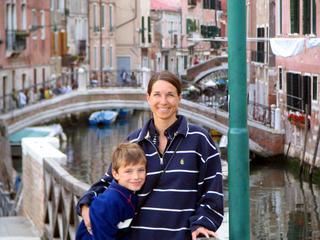
The Venetian cityscape is powered by a completely alien infrastructure in which tires have been replaced by tillers. The garbage man, postman and policeman do the same things they always do, but their vehicles all float.
Seeing a radically different approach to supporting the life of a city is weird and fantastical, like discovering a deep sea thermal vent that supports hydrogen-based life forms. Who would have believed it possible to have a vibrant, modern city which has banished wheels?
Despite its oddities, Venice doesn’t feel like an anachronism. Yes, we rode the canals on an old-fashioned gondola ride, yet our gondolier took several calls on his cell phone while he shepherded us through the canals.
Out of its exotic environment, Venice harvests an amazing bounty of human creativity. A city once dedicated to the sea is now dedicated to the senses. Streets are crammed with shops displaying handmade scarves, paper, glass and masks in bright colors.
Seeing Venice makes you wonder why more cities don’t make the effort to be interesting. 07/10/05
Italy for kids – an amateur’s assessment
It is of course ridiculous to summarize a country after a few weeks of travel, but here are some thoughts after spending six weeks traveling through Sicily and Tuscany, going up through Rome, Amalfi, Florence and Venice, then heading north to Switzerland.
Overall, Italy is wonderful for kids. The Italians are naturally friendly, but particularly friendly to families and children. Not that many people spoke English, but we did alright with a few phrases from the back of our guide book, with lots of expressive gestures thrown in.
Our biggest single travel problem in Italy was dinners – our boys are 8 and 5 and usually go to bed by 8pm, but few Italian restaurants are open by then. We got around this by cooking many of our dinners at home (with incredibly fresh ingredients so it wasn’t like this was a hardship) and just having a number of days where the kids were crabby because they hadn’t gotten to bed early enough.
We found quickly that there was only so much big city sightseeing the kids could take. Over time, we developed the “two marvel rule”: kids can handle about two marvels a day before they melted down due to a combination of crowds, optic overstimulation and heat.
Quick Impressions
- Sicily – fruit and vegetables, ruined ruins, friendly people, narrow roads
- Rome – shock and awe, ransacked ruins, impossible driving, swarms of vespas
- Venice – joy and wonder, beautiful shops, best church interior in Italy (St Mark)
- Florence – wealth and art, bad cafes, most Americans
- Tuscany – gold and sunny, best church exterior in Italy (Orvieto) 07/12/05
Italy Hotel Reviews – the good, the bad, the mosquitoes
Italy, Amalfi — Hotel Bussola (labussolahotel.it) Rating: 8/10 Location near marina, away from touristy grand hotel area. Nice room with balcony overlooking the marina. The hotel has its own dock on the marina set up for swimming — our kids spent the entire day there. Around 180 euros/night (June).
Italy, Rome, Spanish Steps — Hotel Dei Borgononi (hotelborgognoni.it) Rating: 9/10 Near Spanish steps. Very nice suite with sitting room and bedroom. Outstanding service, wonderful quiet oasis in a bustling city. Around 250 euros/night (June). Park at airport and take a cab — do not try to drive to this hotel.
Italy, Sicily, Catania Area — Villa L’Edera (dolcevitavillas.com) Rating: 6/10 On slopes of Mt Etna. Incredible architecture and wonderful pool, but remote, expensive, no internet, barking dogs. 420 euros/night for full week rental (June).
Italy, Tuscany, Orvieto Area — Agro Turismo Locanda Rosati (locandarosati.orvieto.tr.it) Rating: 10/10 Near Orvieto, beautiful gardens, raspberry patch, pool. Spectacular family-style meals made from local ingredients. Outstanding friendly family runs the hotel. 270 euros/night including breakfast and dinner (June). A family could easily stay a week here.
Italy, Tuscany, Greve Area — Villa Marcellana (dolcevitavillas.com) Rating: 7/10 20km south of Florence. Drop dead views, extraordinary gardens, idyllic pool — but road noise and obnoxious dogs. 220 euros/night full week rental (June).
Italy, Venice, Castello — Hotel Ca Formenta (hotelcaformenta.it) Rating: 9/10 15 minute walk from Piazza San Marco, quiet neighborhood. Two connecting rooms overlooking a canal. Very friendly and helpful staff. Around 260 euros/night (July). 07/13/05
The locality of quality
Only a few kilometers over the Italian border into Switzerland, we stopped for the night in Lugano. There we found that a miraculous transformation had taken place – although everyone still spoke Italian, they had forgotten how to make coffee and discovered how to make watches.
Despite the drumbeat newspaper reports of universal globalization, the truth is that there is still an astounding and charming locality everywhere you go. Yes, McDonalds has its tentacles in a surprising number of locations, but what you can find within 100 meters of McDonalds varies delightfully from town to town.
When it comes to quality, everything matters – ingredients, skill in preparation, local tastes and even ambiance. The incredible almond sherbet (mandorla granite) that was universally available in Sicily was completely unobtainable anywhere else in Italy. Even within Sicily every café had its own mandorla recipe so it never tasted the same twice. Vive la difference! 07/14/05
At home in Europe
After six weeks traveling through France and Italy, it took some old fashioned Dutch hospitality to make us feel at home in Europe. We stayed for several days in Basel with family friends who had not seen my wife for over 20 years, but who welcomed us as if we had known them all our lives.
Truth be told, we were homesick after so many weeks on the road and dying for a place where we wouldn’t feel like tourists just passing through. At the house of Hans and Henny Jansonius, we had a sense for the first time of being completely comfortable in Europe.
The Germans, with their endless inventory of human emotions, have two very good expressions for describing these kinds of feelings:
- Gemütlichkeit – cozy ambiance, the comfort of a home kitchen
- Sich wohl fühlen – literally to feel well about yourself, the contentedness of feeling accepted
Days we played soccer in the park and picked local raspberries. Nights we sat outside for home-cooked meals and lively conversation. After four days we left with a new spring in our step, clean laundry and the warm glow of a new-found friendship. 07/15/05
Occupation memories
Our hosts in Basel were both children in Holland during World War II. Over our time there, they related stories from the German occupation of Holland that had eerie parallels to what we see daily on CNN.
The Germans wanted to be seen as friends and protectors of the Dutch, but were instead universally reviled. Most of the schools were closed, food was strictly rationed and basics like bread were unobtainable.
As an eight-year old girl, our hostess thrived playing dangerous tricks on German officers like pulling on water-covered branches to drench them as they walked under a tree. Older girls played far more dangerous games, flirting with the German troops while carrying weapons and supplies for the Dutch resistance in the saddlebags of their bicycles. “Every child understood, even without being told, that you should smile politely to the Germans while doing whatever you could to help the resistance.”
Their city was liberated by the Canadians who came in tanks and brought fresh bread. Her entire neighborhood ran to see their liberators, passing in their excitement through a well known minefield where miraculously nobody was hurt. “When the Canadians distributed white bread, that is the first time I can ever remember being hungry for food.”
After singing songs and dancing with the Canadian troops, people went home thinking that the war was over. What came next though was in some ways the most dangerous time of the war. “After the Canadians came, there were still German troops all over, and if they had a gun, they would kill people just because they could. They had been told that if they were defeated they would have nothing to live for, so they killed many people. For months after the liberation we had to be very careful and stay home.”
It seems in Iraq we are learning again the huge difference between liberation and peace and the long shadow cast by a totalitarian government and its fanatic adherents. 07/16/05
Two types of travelers
Travelers divide into roughly two camps: those who travel to fill their heads and those who travel to fill their hearts. Head travelers are easy to spot – they are all maps, detailed itineraries and cameras. Heart travelers tend to be found in out of the way corners, staring dreamily at ancient walls or errant flowers.
With head travel, the itinerary is easy to create, but the end objective is unclear. With heart travel, there is no particular itinerary, but the objective is achieved with each new adventure. With one approach, you get pictures, and with the other, stories.
“The longer I’m here, the less I feel like I have to go see.” — my wife 07/18/05
Switzerland and Austria hotel reviews – serious price/value gap
P05-07_Lech-8 bigger.jpeg)
The short story: save money, go to Austria.
Switzerland, Wengen — Hotel Caprice (caprice-wengen.ch) Rating: 8/10 — but not worth the price Near Interlocken. Must park car and take train from Lauterbrunnen. Drop dead views of the alps, outstanding service, excellent French chef dinners. Over 600 Swiss francs/night (July) with breakfast and dinner included. Beautiful but not nearly worth what we paid.
Austria, Braz — Hotel Gasthaus Traube (traubebraz.at) Rating: 9/10 — our favorite hotel in Europe Between Zurich and Innsbruck. Great layout, beautifully decorated rooms, outstanding breakfast with fresh breads and air-dried meats. 120 euros/night including breakfast (July). If this hotel were located in Lech, we would check in and might just never check out.
Austria, Lech — Hotel Omesberg (hotel-omesberg.at) Rating: 9/10 Self-described “most beautiful village in the world” — only a slight exaggeration. First hotel in 8 weeks in Europe with Ethernet in the room. Hotel card gives free bus rides, gondolas, and pool entry. Kids’ program (hiking, rock climbing, soccer) for 8 euros/child/day. 150 euros/night including breakfast and dinner (July). Don’t miss Restaurant Rud-Alpe halfway up the ski run — a chic San Francisco restaurant inside a beautiful barn with jaw-dropping views. 07/25/05
The most beautiful village in the world
Through some sort of semi-competitive process which was never completely disclosed, Lech won the right to call itself “the most beautiful village in the world.” This is only a slight exaggeration – the family voted this our favorite stop on our grand tour. Beautiful mountains, rushing streams, and friendly Austrians made it an easy place to stay.
One night we saw lights leading up a ski slope to a little lodge and thought we would pop up to take in the view. Thirty strenuous minutes later we collapsed on the doorstep of an extraordinary restaurant called Rud Alpe. The restaurant looks like an ancient barn on the outside and a hip San Francisco restaurant on the inside, commands a stunning view of the entire Lech valley, and has a similarly stunning menu and wine list. Once we had found it, we contrived to eat as many meals as possible there during the rest of our stay.
Lech has also figured out that it takes a village to make a vacation fun and easy. Anybody staying at a local hotel gets a pass which gives you free rides on the busses, chairlifts and gondolas and entrance to the huge outdoor pool. You can put your children in an all-day program of hiking, rock climbing or soccer for 8 euros per child per day – Lech is the most kid friendly place we have been to in Europe. 07/28/05
Travel-cholia
It was bound to happen sooner or later, but Travel-cholia has finally set in for all of us. After 8 weeks on the road, we are finally sick of sleeping on strange pillows, conducting cryptic conversations with miniscule vocabularies and longing for soft toilet paper.
The full symptoms include a strong feeling that you have traveled a very long way only to discover that the place you really want to be is back where you started. When we hit Hamburg we spent a full week laying around the house and avoiding doing anything culturally significan’t whatsoever. We have each constructed elaborate fantasies involving burning all of our travel clothes.
I long to walk into a bakery where I know the name for the kind of bread I want, or to stay someplace where the kitchen has a sharp knife and a heavy skillet. 08/05/05
On closeness – adults
How do you measure closeness with another person, particularly one you have spent almost 20 years with? More specifically, if you spend a concentrated period of time together with that person, how does it change the relationship?
During the time we have known each other, my wife and I have never spent eight weeks in constant company. Nor have we ever had such a steady barrage of mundane but important decisions to make: where do we stay, how long do we stay, what do we eat, how do we keep the children from driving us crazy without driving them crazy instead?
For some of the trip, we had a well-planned itinerary. For much of the trip, however, we had no fixed plan. These parts were more challenging than we had expected, because children are less flexible travelers – when they are hungry, they have to eat, and when they have had enough, you have to stop. So there were many pitched debates, usually made speeding along the highway, often after a less than optimal nights’ sleep, with kids wailing in the background.
After weeks of making the same kinds of stressful decisions with the same unconstructive interactions, we both started learning more about getting along with each other. Here is what we learned – depending on how you make decisions, your points of discomfort are very different. My wife is a linear, methodical thinker. She wants to gather all the facts to make an optimal decision. On the other hand, I am an intuitive, somewhat scattered thinker. I am perfectly happy making a decision with little (or no) information.
Knowing all this doesn’t make the decision-making process much easier, but at least it helps us understand where the conflict comes from.
Just as pressure makes diamonds, stresses build relationships. To paraphrase Nietzsche, “the vacation that does not destroy your marriage will make it stronger.” 08/16/05
Shadows of Eastern Germany
For the last 15 years, West Germans have been paying an additional 8% income tax to help rebuild East Germany. The results are extraordinary – entire cities completely rebuilt, full of tidy houses with spectacular dahlia gardens. Yet a shadow still remains.
Every city still contains a number of completely dilapidated buildings left over from the communist days, and the Island of Rugen is dotted with ruined estates. Many of the interior roads of Rugen are still half cobblestone/half asphalt, from the old days when the government didn’t have enough money to pave the entire road.
Germans everywhere have stories from the days when East Germany was effectively a prison. West Germans sent monthly care packages to their relatives in East Germany containing everything from chocolate to pencils. Visitors leaving East Germany had their cars searched with guard dogs and mirrors. East Germans who were caught trying to escape got six years in prison, if they were lucky enough not to be shot. 08/16/05
On beeps
One of the first things I have noticed about our new Paris apartment is the beeps. First, there is the sound of the beeps themselves, which, like the police sirens in every country, have their own distinctive dissonance for attracting attention. Every culture has its own ideas about the types of noises that are obnoxious enough to attract your attention but not so offensive as to cause the violent dismemberment and subsequent return of the offending appliance.
Next, there is the sheer number of things that are equipped to beep at you, and here are some real cross-cultural surprises. For example, I never knew that a stovetop had matters to convey of sufficient gravity that they be equipped with their own pesky noisemakers. In fact, it appears that almost every device that can get access to a steady stream of electrons in France has been given the capacity to divert some of those electrons to attract your immediate attention.
Finally, and now we are getting to the subject of monumental design hubris, there is the matter of how long each device feels compelled to make its pleas for immediate attention. For reasons which can only relate to the monumental egos of the machine’s designers, almost every machine in our apartment demands that you perform some act of obeisance (push a button, open a door) before it will sink back into the mute silence which is the preferred state of any machine.
Were these machine designers neglected as children? Is there any other explanation for microwaves, stoves and washing machines that beep plaintively until their owner comes over and gives them the man-machine equivalent of a hug just for doing what they were supposed to do? 09/01/05
Le club hot, hot, hot is alive and well in Paris
Our first day of school for our children, we went out for coffee with some other parents. One of them said, “I have a spare ticket to the Richard Thompson show tonight. Does anybody want to go with me?” Seeing as I was new to the school and all, I waited for a full half-second before blurting out, “me, me, pick me, I love Richard Thompson.”
(note: if you have never heard of Richard Thompson, run, don’t walk, and purchase the CD, “Shoot Out The Lights”)
We met at the Belleville metro station, which is in the 20th arrondissement, across town and firmly on the other side of the tracks from our staid and self-satisfied 16th arr neighborhood. My immensely entertaining companion was an English actor who works in Paris (in French) under the moniker Mr Pomfrit.
Our destination — after stopping at the lovely home of yet another English actor for a few margaritas to fortify us — was a place called La Java. The directions: get out at the Belleville metro stop, walk until you reach the Turkish hookah parlor, turn right and head down a dark tunnel under the collective stares and smoke of the hookah clientele. La Java is at the end of the tunnel down an unlit stairway — you can’t miss it.
The low-ceilinged room was packed with perhaps 200 people sweating in the late September heat, simultaneously smoking a similar number of foul filter-less cigarettes. And of course none of that mattered, because not 30 feet away across the fragrant crowd was Richard Thompson belting out an acoustic set with incandescent fingers.
The audience was transported, as only music can, to some shared place in the human psyche which must be almost exactly as old as consciousness itself, perfectly tuned to the music of the moment. 09/14/05
Just another commute
After 3 weeks of school for the whole family, we have settled into a routine.
We start with the usual morning exercises in cajoling, wheedling and force feeding our children what we believe are necessary nutrients against their equally firmly held beliefs that they should be allowed to eat normal breakfast food like pain au chocolat.
Next we all grab our respective backpacks and metro passes and hit the road. The streets are mobbed with harried but proud parents and adorable kids, many of them dressed in painter’s smocks like they are off to Picasso’s atelier for a quick painting before school.
We walk a block and pop down into the world’s greatest subway – trains come every two minutes on all the main lines (provided that the myriad minor deities in the French transportation unions are feeling appeased that day). Four stops later we pop up again at the Trocadero station and get a heart-stopping view of the Eiffel Tower across the river.
Something about the light makes the walk brilliant up the rue lubeck to the children’s school. Along the way we meet the united nations of parents attending eurecole, each with more or less enthusiastic children in tow.
We get to the school door and attempt to exchange urbane pleasantries with the staff, but I fear that our barbaric accents and very loose grasp of French grammar translates all of our remarks into something that sounds more like, “heap um good weather, huh dude?”
With mixed feelings of humiliation and triumph we set off for our own school, the grandly named Institut de Langue Française. Our walk takes us up the Champs Elysée towards the Arc de Triomphe.
So there we are, sauntering but trying hard not to gawk, cruising up a seriously nice street, turning off on rue Balzac, just to get our literary reference for the morning. A few blocks later and we are at the ILF, ready for another four hours of screaming neurons and fraying synapses as we try to force fit another word for “vacuum cleaner” into a slot that was only built to hold one entry. 09/22/05
French as a terrifying language
Imagine you are an 8-year old boy at school. Your teacher has just written the homework for tomorrow on the chalkboard. Only she has written it in cursive, which you cannot read. Even if you could read the cursive words, you would not understand them, because they are in French. You are writing with a fountain pen, which, when in a temperamental mood, can deposit entire lakes of ink onto the page.
To your right is the only person in the room you are allowed to speak with, Diane (“dee-ahn”). Diane, although a very sweet, speaks almost no English. In your desk is a dizzying array of color-coded notebooks, one for each subject, one for your homework assignments, and one for communication between the teacher and the parents. There is an equally broad array of books for each subject, some of which would no doubt be helpful for completing the homework you have just been assigned, if only you knew what that was.
Welcome to language immersion the French way – who said the reign of terror is over in France? 10/02/05
Being interesting
One of the great catastrophes of life as we know it is the feeling of being less interesting, both to yourself and to others. The abrasive effect of repetition renders almost any activity dull. For example, swimming in the San Francisco bay is thrilling the first time, and always retains the dark fantasy of encountering something with big teeth, but with enough iterations inevitably takes on a mundane aspect something like a chore.
Even the parts we like best about ourselves become suffocating after almost a half a century of admiring them in the mirror, expressed eloquently in the Christine Lavine song about Elvis being “a prisoner of his own hairstyle.”
So why is it that simply changing location is enough to make you interesting? In San Francisco, we were flies caught in our own web of self-imposed constraints, but in Paris the strands are all more malleable, have an entirely different quality.
Not only do we have the opportunity to be more interesting to ourselves (and each other) we find that people are interested in us here too. In San Francisco, we are run of the mill software yuppies, but in Paris we are exotic. We meet actors, art historians, dancers, artists – all of whom are as intrigued by us as we are by them.
Within the ex-patriot community in Paris, nobody has a feeling of belonging or permanence. Everybody is to some extent a misfit and everyone has an interesting story to tell about choosing to be a colorful misfit rather than fading into the woodwork of their own lives.
My older son may have summed it up best when he was describing how he has gotten so many friends at his new school, “I knew I was only going to be here for a year so I decided that if I wanted to have any friends, I would have to try harder.” 10/12/05
A long walk if…
P05-10_villefranche-10 bigger.jpeg)
One of many prodigiously talented parents from Eurecole, Kelly Spearman has a PhD in art history from the Sorbonne and conducts regular tours for the other parents. We tagged along this Friday to visit the Basilica of St Denis.
Rather than giving us a pastiche of highlights à la a Michelin guide, Kelly started with the ruins of the original church located in the crypt and then toured us through the basilica as though we were riding a time machine.
St Denis is located just outside Paris on the main trade route going North to Normandy. Around 220 AD, St Denis and two other brave men were dispatched to convert the heathen Gauls to Christianity. Not long after they arrived, the Romans captured them, grilled them over an open fire and then removed their heads. This being back when men were men, St Denis and his companions calmly picked up their heads and walked a good 10km north before finding a burial site more to their liking. This site became the location of the Basilica of St Denis.
In addition to the saints, most of the French kings and queens are buried at St Denis as well. Some of them, rather unintentionally, even went as far as to emulate St Denis by getting their heads lopped off. It is important to note, however, that none of them had the gumption to pick up their severed extremities and hike the distance to the graveyard themselves. 10/23/05
The pond that launched a thousand paintings
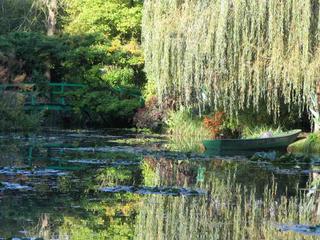
A French woman recently returned from San Francisco and won my eternal gratitude by telling me that the garden at our house there reminded her of Giverny. To find out exactly how much she was flattering us, we decided this weekend to head to Monet’s house and garden at Giverny before it closes at the end of October.
We took the train from Gare St Lazare to Vernon in around an hour, then took the bus to Giverny. We arrived at the gardens, bursting with Dahlias and cosmos in a final fling before winter sets in. Monet’s house was a wonderful portal into the artist’s world – all blues and yellows and packed full of Japanese block prints with their indigo blues and beautifully stylized water scenes.
On the other side of the road was the famous water lily pond – it is nothing short of a religious experience. It is a pond I have stared at many times in paintings at the Met and now at the Musée Marmotton; and have spent hours marveling at the blues and purples and blacks, losing myself in the reflections of the trees, the effervescence of the flowers, the depths of the roots dangling down into the water.
In real life, the pond is every bit as beautiful as Monet depicted it, but somehow even more perfect in his paintings. In real life, my gardens are nowhere near as beautiful as Monet’s, but somehow stay perfect in my memory. 10/23/05
Milk Run at the Musée D’Orsay
In an age where new museums seem to be trying too hard to make a statement about art, the Musée d’Orsay sets the standard for inspiring architecture that equals the paintings it houses.
For all of its strengths, the museum does have one famous flaw. Similar to your local supermarket, they put the good stuff that everybody really wants at the back of the joint so you have to traipse through the entire place just to get your quart of milk or your fix of Monet.
So the trick is to do just what you do when you go to the grocery for milk — pay no attention to all the odds and ends vying for your attention and beeline for the escalators at the back. Once you reach the top of the 5th escalator, you are in impressionist heaven, with room after room of famous greats, mixed in with painters just as great but not so famous, like Redon, whose spiritually intense works were displayed in darkened rooms that preserve their colors but also give them an additional allure. 11/06/05
Paris riots – burnin’ down the house
Two weeks ago, we spent the day in St Denis — the suburb at the center of the current Paris riots. The buildings are a bit run down but the neighborhood is bustling — we toured the church of St Denis, then had a wonderful lunch: couscous with spicy Merguez sausage.
After lunch we strolled through the crowded market streets of St Denis, which featured street vendors roasting corn over charcoal stoves and shops selling honey-covered pastries surrounded by swarms of people and bees. During the day, it felt like walking through the Mission District of San Francisco — exotic, a bit dirty but safe.
At night, however, things are different.
My first week in Paris, a friend pulled me aside and said “the night in Paris belongs to the Arab youth.” The back story is that there was a large migration of “temporary” workers from Africa in the 50s to provide cheap labor to help France’s postwar expansion. Only they never did make that return trip and now their unemployed grandchildren are raising hell with Zippo lighters all over France.
Like the volcanic eruptions that issue every ten years or so from the slums of Philadelphia or LA or New Orleans and shake the American self-identity, France is experiencing the rage of the underclass. 11/07/05
When French words go bad
Due to the Paris riots shenanigans ringing Paris with a halo of burned out cars, the government recently announced a curfew. Now “curfew” is one of those outcast words in English that really makes no sense on its own and has no interesting resonances.
However, in French, the expression is “couvre feu,” which translates literally as “cover fire.” Back in the bad old days (long before Molotov cocktails had been invented) you covered the fire so the bad guys couldn’t see you at night, and of course once you did this it was hard to do crossword puzzles or watch TV so you pretty much had to stay put.
It is relatively easy to see how “couvre feu” got mangled into curfew over a few beers in one of those seedy seaside towns around Dover, and we have been stuck with curfew ever since. 11/10/05
Dead white french women – a visit to Cimetière du Père Lachaise
Last week we spent a day in Paris visiting the tombs of famous women at the Cimetière du Père Lachaise. The best part of the visit was simply wandering along curving, tree-lined paths surrounded by scads of small, moss-covered mausoleums, looking like the world’s poshest collection of run-down outhouses.
The secret to the success of the cemetery — as with many notable French accomplishments — was Napoleon. He was determined that Paris should get a “modern” graveyard, and to make sure that people would be dying to get in, he imported a number of France’s most famous dead people into the cemetery.
The high points of the tour were learning about the wild and wonderful life of Colette, and the love story of Héloïse & Abélard. Colette single-handedly jump-started the Parisian hair salon by becoming the first woman in Paris to bob her hair. She also wrote the Claudine series of easy-to-read French books, making her my new favorite author.
Héloïse & Abélard have a cosy little mini-gothic mausoleum in a secluded area of the cemetery. Theirs is a love story from the middle ages that makes Romeo and Juliet look like lightweights. 11/13/05
Paradise for pools – hell for swimmers
With over 30 public pools, Paris appears at first glance to be a swimmer’s mecca. In order to use the pools, however, you must overcome some typically Parisian challenges.
The first challenge is that the public pools are rarely open to the public. For example, during the week, the pool nearest me is closed Monday and open only two hours a day Tuesday through Friday (from 7-8am and from 12-1pm).
This brings us to the second challenge: figuring out which pool is open when you want to swim. Each pool has completely different but equally arbitrary hours, and there is a city-wide conspiracy to provide this information strictly on a need-to-know basis.
After several frustrating excursions to lovely but not-open-to-the-public pools, I spent an entire morning decoding various brochures and sleuthing over the web for the Paris swimming pool schedule. Through the research, I finally found My Perfect Pool: large (50m), within walking distance, and open from 12-7 each day.
The high point of this week was finally swimming at My Perfect Pool. After months of feeling like a bemused outsider, I had finally mastered the complexities of Parisian pools. With this under my belt, I felt confident that soon all the mysteries of Paris would yield to me.
On my way out of the pool I happened to glance at the bulletin board. There, a small, hand-written message indicated that My Perfect Pool is closing at the beginning of December for 18 months of repairs. 11/18/05
Beaujolais Nouveau – the real menace to tourists in Paris
With all the fuss and hubbub around the Paris riots, a much more immediate and important danger to Paris tourists emerged just last week: the Beaujolais Nouveau! The Beaujolais Nouveau festivities around France are delightful – kind of like St. Patrick’s Day in the US, but with that special intensity that the French reserve for all things wine.
Be forewarned, however, that the wine itself is anything but delightful. Beaujolais Nouveau is a kind of a Frankenstein wine created by performing unnatural acts with grape juice. Specifically, carbon dioxide is pumped into the fermentation tanks (a process called carbonic maceration) – this accelerates the wine’s aging process and also produces famously punishing hangovers.
The resulting beverage has a lurid purple color not found elsewhere in nature, an acrid odor and a taste that is somewhere between cherry Kool-Aid and vinegar. Every bar is plastered with marketing propaganda and every bartender appears to be working on retainer to move the stuff as quickly as possible. 11/20/05
Forget the turkey – check out this cheese plate!
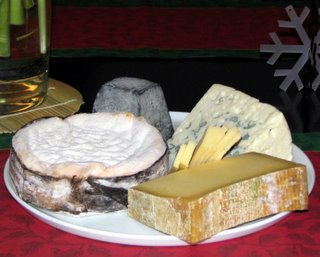
Let’s agree that the point of Thanksgiving is to assemble an array of the best foodstuffs the local terroir can produce, thereby inducing your guests to over-consume to a point slightly beyond discomfort but stopping just short of actual pain.
Here in Paris, the French turkey actually looks recognizably like a bird, unlike its American counterpart which looks like the feathered equivalent of Arnold Schwarzenegger in his most excessive body-building days. Ounce for ounce, however, the single most tempting foodstuff for a Thanksgiving feast in Paris is the cheese.
Over 3 days of over-indulgence, we sent away 32 guests with light hearts and heavy guts, thanks to a cheese plate featuring all the major food groups: goat, cow and sheep. All the cheeses were bought at our local cheese monger in the rue de l’annonciation, who only sells cheeses produced by small artisan farmers from un-pasteurized milk (au lait cru).
The royal line-up:
- Mont d’Or – the original “don’t wait too long to eat it or it will just melt into a puddle and slide away.” Compared to Mont d’Or, brie is a diet cheese.
- Beaufort – a hard cow cheese with a fragrant rind that makes you swear you’d just stepped into an alpine barn. Just like Gruyere only much, much better.
- Valençay – a beautiful pyramid of goat cheese that when perfectly ripe (bien fait) has a firm interior and molten exterior.
- Roquefort – produced on artisanal farms with un-pasteurized milk, it simply can’t be compared to the dry crumbly stuff you get clumped onto your pear and endive salad back in San Francisco. 11/28/05
Christmas at Chartres, 1000 Years Later
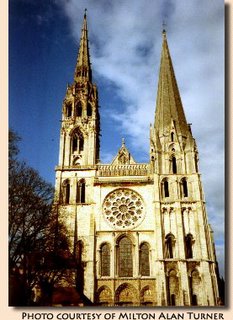
On a cold grey winter day, with my gimpy mother in tow, we made a pilgrimage to the cathedral of Chartres, 100 km from Paris. As befits any true pilgrimage, ours was a journey filled with surprises, adversity and the ultimate triumph of the human spirit over the petty worldly snares that the French seem particularly adept at weaving.
1000 years ago, pilgrims from all over Europe streamed to Chartres to invoke the help of the Virgin Mary by means of the holy relic on display at the cathedral — a piece of the garment Mary was wearing when she gave birth to baby Jesus.
Our pilgrimage was no less focused — to learn about the famous stained glass windows of Chartres from the world’s foremost authority on the subject, Mr. Malcolm Miller. After a series of typically French bureaucratic obstacles, we finally found Mr. Miller, who arrived and gave us a private tour.
In one hour we were only able to scratch the surface of the church, its art and its history. The most interesting feature is its 170 stained-glass windows from the middle-ages, each of which is a mini-sermon delivered in symbols and light. The most interesting windows drew parallels between the story of Adam, the man who brought death into the world, and Jesus, the man who vanquished death.
The sure-fire formula for transforming “non” to “oui” with a French functionary:
- Always begin with “bonjour monsieur” or “bonjour madame” — this is non-negotiable
- Understand that “non” really translates as “I have the power to say no”
- Smile politely and wait expectantly for them to miraculously discover a hitherto-unexpected means of overcoming the objection they themselves just raised
- Repeat as necessary 12/04/05
The shock of the familiar
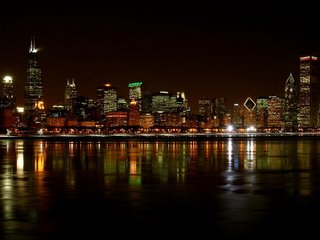
I have been spending the week in Chicago helping my mother limp around after her (very successful) knee surgery. This is the first time I have been back to the US for an extended period since May, and has entailed more adjustment than I had anticipated.
The best thing about being back is that the fog of miscommunication that has dogged me across all of Europe has been magically lifted. Gone are the knot in the stomach and thickness of tongue that precede any attempt to communicate in a foreign tongue.
The second best thing is to be back in the land of “would you like fries with that”-style service. In Europe, every commercial interaction begins with your trying to create a good impression with the server so that they will deign to interact with you. In Chicago, every interaction begins with an almost puppy-like enthusiasm on the part of the server to make your day.
At the same time, there are things I positively pine for after just a few days here. Curiously, the top of the list is missing hearing French spoken — the musical cadences, animated features of the speakers and the infinitely nuanced gestures that go along with it.
Summary of things I miss about the US:
- Showerheads that stay put
- Phone numbers that make sense
- Big smiles and optimism in general
Summary of things I don’t miss about the US:
- The CostCo effect: the generalized willingness to trade-off quality for quantity
- Oversized food portions
- Cheerfully incompetent staff — give me frosty but knowledgeable help any day 12/08/05
Chilly view of Eiffel Tower
P05-12_Tour-effiel-photo-shoot bigger.jpeg)
On a very crisp Saturday morning recently, we got up at 7am and raced down to the Trocadéro plaza to pose for our Christmas photo. There is a narrow time window early in the morning when there is enough light to take a picture but before the flood of tour buses arrive.
With a shutterbug friend manning the camera, we tried to pretend that we weren’t tired and freezing. Halfway into the photo shoot we got swarmed by that Paris street staple, the obnoxious trinket salesman.
The last few shots were something of a cat and mouse game — with cranky, cold kids, lurking vendors and the odd tourist standing transfixed gawking at the Eiffel Tower all conspiring to try to ruin our perfect Kodak moment. 12/12/05
Off to play in the snow
P05-12_Naarden-11 bigger.jpeg)
One of the great advantages of French schools is their plentiful vacations — typically 2 weeks for every 8 weeks of school. For us slacker parents, however, each school vacation is an opportunity to explore a new region of France. We are off early tomorrow to ski at Val d’Isère for a week, then go to Holland for Christmas with my wife’s 95-year-old grandmother.
Last week was cull week for the kids’ ski gear — not much made the cut. Paris has a remarkable dearth of sporting stores. Decathlon has an almost absolute monopoly here with a unique value proposition of high cost, moderate quality and limited selection.
We will be off the Net for the next two weeks — Merry Christmas! 12/15/05
Heaven in the Alps
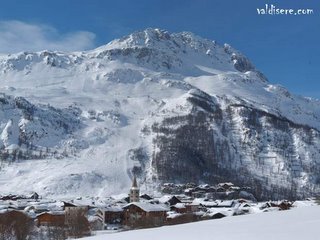
For beauty and luxury, nothing beats a catered chalet in the French Alps. Our week in Val d’Isère was as close as we have come to vacationing perfection.
We set out from our apartment in a heavily-laden taxi for a drive along the Seine to the Gare de Lyon. From there we took a train directly to Bourg St Maurice in the French Alps, where we were met on a snowy afternoon by a van driver with champagne and snacks and whisked off to our chalet in Val d’Isère.
Our chalet slept 10 people — our family, my wife’s dad, and a lovely family of 4 from Sheffield. Satisfying our every whim was a crew of three delightful hostesses — a British songbird, a Scottish actress and an Irish chef. Over a week of wonderful meals and late night conversations, we managed to break every conversational taboo, trying — mostly unsuccessfully — to explain to ourselves and each other the tangled stew of world politics and religion.
The most trying day of the week was when we hired a guide to show my wife and I the off-piste skiing. The short answer was that this early in the season there is no off-piste skiing. We spent the entire day hiking to the top of one rock-strewn couloir after another, with the guide intoning at the top of each one: “zhis vill be fantastique skiing in February.”
Arriving back at 10pm in a fog-filled Paris, we experienced for the first time the smoky Gare de Lyon captured by Monet, with everywhere a shimmering mist and a feeling of magic. 12/27/05
Holidays Elsewhere
In a year full of displacements, Christmas abroad was particularly disorienting — at once magical and strange. To be close to my wife’s grandmother in Holland, we rented an apartment in Naarden which we stuffed with holiday cheer. This included a squat, heavily-decorated Christmas tree, bunches of tulips and squadrons of tea candles.
All our lives we have journeyed back to our family homes in Eugene, Oregon for Christmas. Instead, our first Christmas dinner away from home was concocted in yet another efficiency kitchen with its wafer-thin cookware, dull knives and tired, temperamental stove.
After the extravagant specialization of Parisian food shops, it was painful to be back to a land of supermarkets, bad bread and one cheese (Gouda, albeit with infinite variations). Dutch markets have their own compensations, however, including Roggebrot (black full grain bread), Stropwafeln (small waffle cookies) and Poffertjes (mini pancakes).
On Christmas morning, our boys generated their own waves of holiday cheer. My younger child’s present was addressed first to San Francisco, then to Paris, then to Naarden — proof positive for him of Santa’s global reach and excellent E.D.L. (elf-driven logistics).
My wife’s grandmother also loved being in the circle of a family for Christmas. Despite the unfamiliar surroundings, the combination of family, flowers and enthusiasm of our youngest and oldest participants made it a successful and memorable Christmas. 12/29/05
Best of European Travel 2005
After six months crisscrossing Europe with kids in tow, here are our personal favorite spots for 2005:
- Most beautiful spot in Europe: Wengen, Switzerland — Hotel Caprice (caprice-wengen.ch). Looking across a deep valley at a waterfall that tumbles straight down over 1,000 feet, hiking across a carpet of flowers masquerading as an alpine meadow, listening to the oddly soothing clonking of the cow bells. Not coincidentally, also the most expensive spot we stayed.
- Best summer resort for kids in Europe: Lech, Austria — Hotel Omesberg (hotel-omesberg.at). Almost as beautiful as Wengen and much more kid friendly. A lovely place to rent bikes, hike everywhere or just drop the kids off at a local soccer clinic and spend the morning drinking coffee and munching pastries.
- Best agro-turismo in Italy: Locanda Rosati (locandarosati.orvieto.tr.it). A working farm with an excellent kitchen and a luxury swimming pool, where the kids can pick raspberries in the morning, lay around the pool all day and milk the cows at night. Close to the gorgeous hill town of Orvieto in Tuscany.
- Best ski chalet in the Alps: Chalet Chardon, Val d’Isère (lechardonvaldisere.com). An incredibly pampered week in a luxurious catered chalet with exquisite food, a delightful staff and panoramic views. Come late January or February when more of the mountain is open for off-piste skiing. 01/02/06
Parisian literary salons – alive and well
As an example of the devious lengths to which the mind will go to avoid doing “real work,” I misspent an entire day this week delving into an obscure episode of the novel “Ulysses” by James Joyce.
How did this happen? First, we found a wonderful literary salon in Paris that happened to be studying Ulysses, which was initially published here. We then found a great English language bookstore in Paris, Red Wheelbarrow, in one fell swoop ruining a New Year’s resolution about reading only books written in French.
The last link in the chain was when I got a bee in my bonnet to track down a reference to the Arian Heresy in Ulysses — resulting in four pages of turgid, toe-curling fodder for the global Ulysses de-obfuscation association.
Reading the full article will demonstrate beyond the shadow of a doubt that I: a) have way too much time on my hands; b) thought way too hard about Dan Brown’s Da Vinci Code; and c) am capable of going to extraordinary lengths to avoid writing on the topic I am supposed to be addressing. 01/11/06
Fun with sharp sticks – fencing in Paris
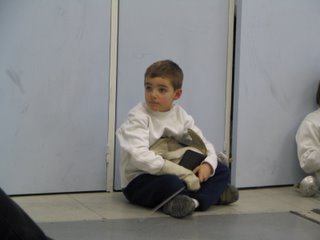
Of all our many shortcomings as parents, perhaps none are quite as glaring as our inability to instill any sort of pacifistic tendencies into our children. Every object is transformed in their chubby hands into a weapon of devastating power.
At some point, we shifted our focus from prohibiting violence to channeling the violence (it’s ok to hit each other with sticks, just don’t use sharp sticks). In keeping with this philosophy of appeasement, it was only a matter of time before the sharp stick injunction went by the wayside too.
At his school, my older son befriended a girl who was taking fencing classes. Last Saturday we took both boys for their first lesson. At issue for them was not a fear for bodily well-being but the much more precious commodity of self-esteem — the only language spoken at the school is French. My older son declared that he had thought so much about the difficulties of learning fencing in French that his tummy hurt. My younger child announced that he was going to make the instructors repeat everything in English.
Every child dreams of being transported into the middle of a Three Musketeers movie — last weekend that dream came true. The sight and sound of 30 children beating on one another with swords puts the action scenes in any Three Musketeers movie to shame.
We have now retreated to the almost completely untenable parental position that it is ok to hit each other with sharp sticks as long as you are both wearing padding. 01/16/06
Elephant plumbing
For our kids, winter in Paris means Circus time. Their tents and high-class squatter villages pop up all over the city at the start of the year.
On Saturday, we took my older son and 14 friends for a late birthday party to a circus near where we live — Cirque Alexis Gruss. The circus is located in the Bois de Boulogne, sort of a super-sized Central Park on the west edge of Paris and a 20 minute walk from our apartment.
The most harrowing part of the day was the first hour, when the kids descended on our apartment for cake. Just think of the mayhem a dozen hyperactive 9-year-olds armed with lemon soda and chocolate cake could wreak on an 80 square meter apartment!
After that, we marched at near-military speed to see a charming old-fashioned circus with jugglers, acrobats and horseback riders, nearly all of whom were named Gruss. Despite the many jaw-dropping feats, the moment which made the most lasting impression on the children was when the elephant took an unscheduled potty break in the middle of the ring. 01/22/06
All the time in the world
One of the great luxuries of being new in town is that you have nothing to do. There are no piano lessons, no swim meets, no dinner parties — only white space on your calendar as far as the eye can see.
Even in a boring city, this is bound to change, but in Paris the change is accelerated. My once pristine calendar is now a mass of illegibly-written entries. It’s Thursday and I haven’t had a single relaxing, sip-coffee-at-home morning yet this week.
On the other hand, I have wine-tasted, learned how to make blanquette au veau, gone to fencing and music classes, and so forth and so on. Maybe Americans are just genetically not up to the challenge of sustaining la dolce vita. 01/26/06
How to tell a French person
One of the fond hopes that we parents had in bringing our children to France was that it would teach them to be more understanding and accepting of other cultures and points of view. Therefore I had a warm glow of satisfaction and even pride this evening when my six year old son announced that he had a sure-fire way to tell if someone was French.
I inquired, “how is that?”
“Easy,” my younger child replied. “They salt almost all of their food.”
To understand this conversation, you have to go back to last May, which we spent in Italy. Our boys — knowing of their imminent exile to Paris — were desperate to see what French people were like. As luck would have it, we had lunch in Sicily next to a table of French people. This table made a big impression on our boys because one of the men salted every single piece of food he was served, including the bread.
Over time, they have even embellished the story to the point where they now claim that the salt-aholic Frenchman exhausted the contents of three full salt shakers during his lunch.
I certainly hope that European children don’t hang on grimly to their negative first impressions of Americans. 01/30/06
Blogging and interviews – a volatile mixture
In my blog posts, I have tried to write about things that are interesting and relatively inoffensive. I have also attempted to avoid typical stereotypes, with the notable exception of my previous post.
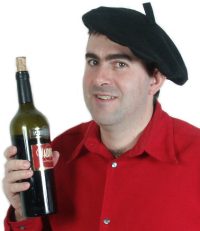
So it should be no surprise that it was when I had a completely cheesy faux-frenchman picture at the head of my blog that I conducted a series of job interviews…in Paris…with real frenchman.
Each of my interviews started with the interviewer’s observation that they had just read my blog followed by a pregnant pause. Luckily, they all had a good sense of humor, but it is a bit of a balancing act to combine a semi-humorous blog about real life observations with the more buttoned-down and mostly humor-less world of business.
There is in fact an entire blog on the topic of mixing real world writing with business, as well as an accompanying book (movie to follow shortly?) shamelessly titled naked conversations. 02/10/06
Improving your skiing – the hard way
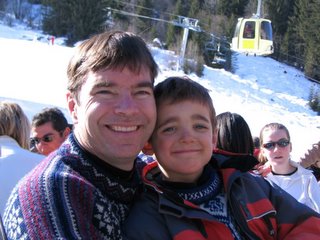
We are in the middle of a two-week ski vacation, one week at la Clusaz and one week at Meribel. Like most parents, we can’t just let our children enjoy themselves on the slopes – we are genetically programmed to improve them.
Thus, when we got my younger child going with ski poles and a few runs later he had a major blow-out of a fall, we gave him a pat parental lie/line that “if you aren’t falling then you’re not trying hard enough. Falling is just a way to show you that you are improving!”
Today, my wife took a bad fall on a morning run in Meribel (steep run + lots of ice + stomach flu = trouble). We went to the excellent on-slope medical facilities, determined that she hadn’t broken anything, then rounded up the kids from ski school.
On being told that his mother had taken a bad fall and being presented with her wearing a sling and a sheepish look, my younger child immediately responded, “mommy, you must be improving a lot to be taking falls like that!” 02/12/06
Ahh, the Alps
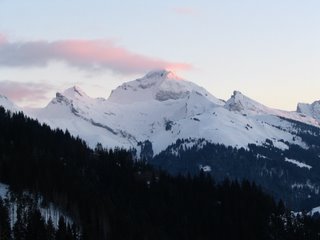
For two weeks during winter, much of Paris clears out for the Vacance d’Hiver (not to be confused with August, when all of Paris clears out).
With the superb French train system you can be whisked from burbs to bergs in about four hours. This time we went to the La Clusaz ski report and stayed in a sleepy village of Manigod.
We knew we were in a small town when we found that the street going up to our chalet was not plowed, meaning that we had to schlep luggage, groceries and kids up and down an icy hill all week.
The view outside the chalet was one of those extraordinary, only in the alps visions of endless snow-capped peaks. The chalet next door to us had a big barn and the whole neighborhood was dotted with picturesque (and thankfully odor-free) manure piles next to each barn, often accompanied by a sign advertising Reblochon cheese for sale by the farmer.
The la Clusaz ski resort is really a collection of 6 or more small skiing operations, each with 3 or 4 lifts and a couple of restaurants.
The food is excellent, as long as your idea of excellent includes vast amounts of melted cheese. The top 3 specialties are fondue (melted cheese with bread), raclette (melted cheese with potatoes) and tartiflette (melted cheese with potatoes and bacon). Every meal concludes with a broad selection of local – you guessed it – cheeses. Who could ask for more? 02/19/06
End of the endless summer
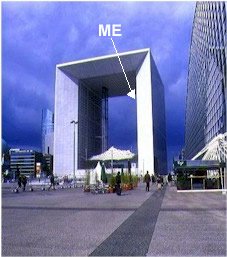
After months of dogged resistence to playing any sort of useful role in society, I finally broke down and got a job. There is some sort of puritan, masochistic work ethic deep in my genome which just doesn’t let me feel comfortable unless I am stressed and out of control. Or as one of our French friends said, “men his age don’t feel powerful unless they have a job.”
Our Paris routine is very ex-pat-centric, cocooned within a group of mostly American friends from our children’s school, from INSEAD and from the American Cathedral. Outside of the incredible pastries, there are days when you would hardly know we were in a foreign country. Working in a French company is one way to see more of what France is about.
For example, my French speaking skills have been stuck at boulangerie level for months now. In fact, my biggest fear on my first day of week was having to introduce myself to the company in French. The introduction went fine but I now have a huge incentive to get truly conversational.
The company I joined is called Reportive. They produce reporting tools for companies with complex reporting needs, such as sales performance reporting. Currently, almost all of the pharmaceutical companies in Europe and many of the Automotive companies use Reportive tools to provide reporting. However, they are not well known outside of the European market, so the challenge is to help them grow in the US.
My job is chairman of the board, a fancy title for someone who still owns a business suit and can look grave when the situation calls for it (meaning that I am 50% qualified for the job). My museums seen per week average is going to take a big hit, but my applied understanding of French culture should have a big spike. 02/25/06
A Sunday Paris lunch
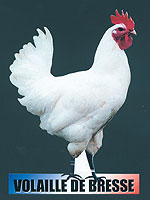
A benefit of working in a French company is having French colleagues to ask us over for for the sacred Sunday lunch. This Sunday we were whisked into a completely different world – the tightly connected world of French families.
Over the course of the 3 hour lunch we collected 10 children and five adults from four different families, interrelated through family and school ties. Most of the adults had gone to the French equivalent of MIT, Ecole Normal Superior.
The conversation was conducted using a nearly incomprehensible melange of Franglish, with everybody doing their level best to communicate using their least comfortable language. The topics ranged from favorite interpreters of the Goldberg Variations to the name of Alexander the Great’s horse (and of course politics, that most dreaded of all subject for Americans overseas).
The centerpiece of the meal itself was a roasted Poulet de Bresse – the queen of French chickens. To accompany we had a 2000 Margaux, Chateau Giscours, easily one of the best wines we have had so far in France. Desert was an incredible looking chocolate cake from Lenotre, but by the time desert rolled around our ranks had been swollen to the point where there were not enough slices to go around. 02/26/06
French Coffee – Puncturing the Myth
As someone who has always felt that “French Roast” was the epitome of fine coffee and that the “French Press” was the epitome of fine coffee making, I came to France with high hopes for their coffee industry. I think it’s only fair to set the record straight and report that French coffee is not what we Americans think it is.
Despite looking hard, I have yet to find anything remotely approaching what we call French Roast coffee beans here. Nor have I ever seen a French press used in any French restaurant.
Despite the high quality of almost every other French food item, when it comes to coffee, the French punt. Even very high end stores like Hediard have pathetic light brown coffee – asking for something darker only produces a kind of incredulous stare (although asking the lackluster staff in a Hediard store ANY question produces a very similar response.) There is only one store in our arrondisement that roasts its own coffee beans, and its efforts are pretty puny compared to fanatics like Blue Bottle Coffee in the Bay Area.
In France, coffee means espresso, ordered as a “petit café.” What you will get then is an espresso that tastes ok as long as you’ve never been to Italy, where barristas are only slightly behind the Virgin Mary in cultural reverence. If you order anything other than a petit café, all bets are off. For example, a “grand café” may be a double expresso or just a single with lots of water. The amounts and temperature of the milk served in any coffee/milk variation tend to be even more extreme.
At work, that most revered engine of American commerce, the coffee maker, has no place in the French enterprise. Instead, they have sort of coffee dispenser monstrosities that make single servings, each one in its own plastic cup with its own plastic stirring spoon. My proposal to re-energize the French economy would be to reintroduce French Roast and the French Press into the French workplace and watch the productivity soar! 03/04/06
Planning the perfect French weekend in the perfect French club
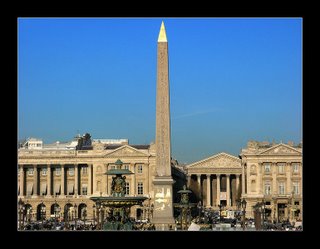
Here’s a head-scratcher: what would constitute the perfect weekend in France? Over the last six months we have wrestled with this question and finally come up with an answer (or at least a proposition we plan to test) – an over-the-top wine and food trip to Burgundy.
To mastermind our perfect French weekend we tapped the talents of Alexandre Lazareff, a master sommelier and overall funny guy who hosts monthly wine tastings here in Paris that we have been attending over the last six months. He also happens to own a small vineyard in Burgundy and writes wine reviews for Le Figaro, so he is the right man for this kind of delicate mission.
To plan our bold expedition, Alexandre and I got together at his club, modestly named the Automobile Club de France. I should have been warned by the fact that it sits next to the swank Hotel Crillon on the Place de Concord. Nonetheless, I showed up in business casual, expecting to see a place with lots of maps on hand and maybe some tips on how to change tires on busy French freeways.
Instead, I found myself in an exquisite gentlemen’s club straight out of the 18th century. At the entrance, I was politely but firmly issued a roomy coat and tattered tie to conform to the club’s equally 18th century dress code. Upstairs was a dining room with 30 foot ceilings looking out onto the vast Place de Concord.
Over cocktails and peanuts we talked over the details of our April weekend in Burgundy: four wine tastings at local chateaus paired with four gourmet meals, each with their own wine tastings. These tastings will explore Burgundy versus Bordeaux wines; new world versus old world Pinot Noirs; grand vin de Burgundy; and terroirs of Burgundy.
Along the way we will slog over the terrain of Burgundy and visit local markets. Probably the biggest difference between California and French wines is the emphasis that the French put on the relationship between the region and the wine – all lumped into the complex term terroir.
Terroir means everything from the soil to the micro-climate to the culture to the locally produced foods for a particular region. In California, you might know that the wines from the Howell Mountain region of Napa are particularly good, but nobody spends too much time talking about why that is – terroir in California is more a matter of branding than education. 03/12/06
The French work culture – a couscous goodbye
The US and France have one unfortunate thing in common right now: they are both adept reinforcing their negative stereotypes around the globe. For the US, this means sticking to the unrelenting “bad cop” routine – for France, this means endless photo opps featuring riot police facing down poorly behaved citizens.
Working in a French company is a marvelous window into French culture that you don’t get reading the USA Today. Despite the American stereotypes about an atrophied French work ethic, the 30 people at my software company in la defense work as hard as any Silicon Valley startup: in at 9am, out after 7pm. In a US company, we usually calculate 220 productive days per year per employee. In France, with it famous penchant for long holidays, this number is still 210 productive days per employee per year!
As befits a culture with a much longer history than our scan’t 200-year American odyssey, there are many charming refinements in the French approach to work. For example, when you arrive at work, the custom is to shake hands. Every hand! This means the first five minutes or so at work is a slow ramble down the hallways of the company pressing the flesh and exchanging quick greetings.
Not only are the greetings more leisurely and refined, so are the partings. For example, the ex-CEO of our company still comes to work regularly and has been very helpful in transitioning to his successor. In France, the personal relationships extend past the busines relationships – my experience in the US is that the personal relationships are usually subordinate to the business relationships.
As another example, one of our sales reps is leaving to start another business with her husband. By way of farewell, she brought a couscous dinner for the entire company, complete with wine. This being a true French meal (my children’s favorite “French” food is couscous), the wines included a sweet aperitif wine meant to be drunk before couscous and a more mainstream wine for drinking with couscous. When was the last time a departing employee bought you and the rest of the company dinner? 03/19/06
The terror of language
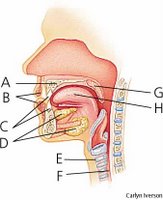
It is one thing to chat about cheese in the fromagerie and a totally different experience to comfort a distraught employee in an alien tongue. After six months, my French is adequate for everyday transactions but pitiful for true communication.
I had a situation this week where an important and respected employee was very unhappy. As I am in theory responsible for the overall well-being of the troops, I realized that the time had come for my first adult conversation in French.
Reviewing my humble French vocabulary, I hurriedly wrote down key phrases on a cheat sheet for my upcoming conversation. Words like désolé, confiance and jugement suddenly had a barbaric sound and near-complete lack of meaning.
In the conversation that followed, I felt very much like the wizard of Oz poking at a vast array of buttons and levers in the foolish hope that some combination of noises would create the desired response in the listener. The words I had in my heart seemed to have no connection with the noises coming out of my mouth.
And that was when the magic happened. Despite the inadequacy of the words, or maybe because of them, I suddenly realized that everything I was attempting to say so inarticulately had nonetheless been both communicated and understood.
Just the act of trying to be comforting in such a difficult situation had more eloquent than any words I could have come up with. Our confidence in words is misplaced. As always, it is the actions that speak more loudly.
- chris 03/26/06
(Momentarily) proud to be American
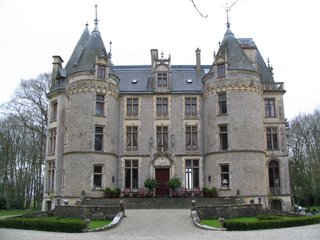
We just returned from four days in Normandy touring the D-Day beaches. The scenery is beautiful and green in the way that only occurs in places which get rain 3 days out of 4 year-round.
The various D-Day museums dotted throughout the area are well done, bringing an extraordinary chapter of world history to life. Even better, they bring back a (simpler?) time when being an American was an unalloyed good thing.
World War II played to all of our strengths – the American tendency to see everything in terms of black and white, as well as our over-the-top commitment to causes and ideals. In short, all of the things that have gotten our foreign policy into trouble since World War II!
We were staying in a lovely chateau near Utah Beach (http://www.islemarie.com/), where the walls in the drawing room still sport damage from the battles in June 1944. The picture above is of the main chateau building.
Over four days visited the Memorial Museum in Caen, the Utah Beach memorial, the Paratrooper’s museum in Mer St. Eglise and the Pointe le Hoc memorial. Each of these covered the D-Day battle from a different point of view and they were small enough that the boys did not get too bored walking around all the exhibits.
Between the brisk sea air, the fresh oysters and the reflected glory of one time anyway where America was unambiguously on the side of the angels in history, a week in Normandy made for a delightful family break. 04/15/06
With chocolates, timing is everything
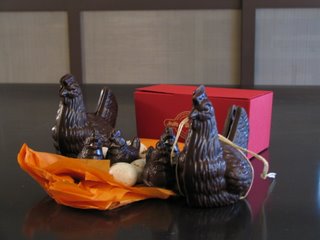
Very near our apartment is a delightful chocolate store, Regis, with the best dark chocolate truffles I have ever had.
Not those awful monstrosities that abound in American chocolate shops with the hard, tasteless shell and the bizarrely flavored goo on the interior, but the ones that taste like a little dollop of mousse au chocolat made just that much more intense and perfect by being bite-sized.
Anyway, Regis is the spot to get these beauties and like so many other foodstuffs around here I have developed a bit of an addiction to them. Nothing I can’t handle, but there you are.
So I breezed into the shop last week and asked the woman for my weekly fix. She gave me a horrified look and then said, “but monsieur, truffles are for Winter time! Truffles are for Christmas! It’s Spring now, we have no more truffles.”
Now I can understand that strawberries have seasons and peaches have seasons but never would it have occurred to me to declare an arbitrary beginning and ending to the truffle season.
I managed to console myself with the chocolates du Pâcques, although this time I am going to be careful not to make it an addiction. Even I can tell that those cute little chicken and egg chocolates are not going to be around for long. 04/23/06
Love among the vines
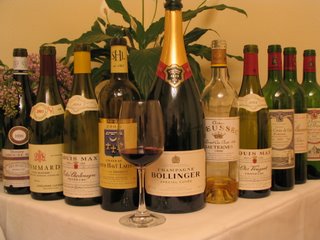
Last Friday we joined forces with 4 other couples and headed to Burgundy for the wine-tasting trip of a lifetime. We were led by Alexandre Lazareff (alazareff@capetcime.fr), a mountain-climbing, extreme skiing, internet entrepreneur and Figaro wine critic all wrapped into a humorous, charming, high energy package.
After an exciting, everyone on board with seconds to spare departure, we were whisked away by the somewhat magical French TGV train from Paris to Burgundy. Over two days we tasted 60 wines, while also having two of the most memorable meals of a lifetime. Despite this ferocious pace, we all managed to be remarkably well-restrained and escaped the weekend a few pounds heavier but none the worse for wear.
We talked to the vintners, walked the vineyards, felt the dirt (in the olden days they used to taste the dirt as well) and marveled at the mosaic of tiny plots that make up Burgundy. The weather was beautiful, the people were friendly, the vineyards were just starting to bud and for us wine-lovers, love was in the air.
Our favorite stop was at Chateau de Mersault (www.chateau-mersault.com), where we tasted incredible Mersault white wines and Volnay reds. A close second was at the very stylish Louis Max winery (www.louismax.com), where we tasted a ’76 Corton that stands as the single best red wine I have ever tasted.
So what did the best wine I ever tasted taste like? This is going to sound really weird, but to me it tasted like dirt – an incredibly fine taste of the chalky, dry, clay soil that characterizes the region of Burgundy. I know this doesn’t sound too appetizing, but throw in an aroma of mushrooms and a sense that you are drinking time itself (how old were you in 1976 anyway?) and it makes for a magical experience.
The winemaking philosophy of the area is infused with the belief that the key to a good wine is suffering (maybe this has something to do with the fact that all the major wineries were originally started by Catholic monks). The wine must not only suffer on the vine (watering vines or protecting them from frost is considered cheating) but also in the barrel (temperatures are carefully controlled to slow fermentation to a crawl).
What did we learn? Burgundy is a place that is impossible to understand from a distance and impossible to forget once you have visited. 05/03/06
100 to 1 hardly seems fair
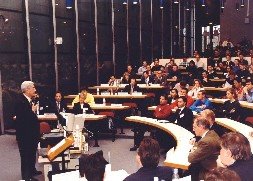
I started teaching my first full class at INSEAD last week, ponderously titled “Venture Opportunity and Business Model.” The goal of the class is to help MBA students create, evaluate and improve new business ideas.
I have a little over 100 students signed up for the class, which means that I am teaching back to back sessions of 50 students each. I lecture for 90 minutes, pant for 15 minutes, then lecture for another 90 minutes.
Although I have been teaching as a guest lecturer now for over 6 months at INSEAD, the experience of having full responsibility for a class makes this a completely different gig. As a guest lecturer, you waltz in, spout off for a bit, then waltz out, leaving the professor who invited you to try to shoehorn whatever you said into the rest of the course material.
Being in charge of doing the shoehorning is a big responsibility. Staring into the faces of 50 students waiting to be taught something useful is something like being a mamma bird faced with 50 open beaks – where do you find enough worms to feed them all?
There is kind of a secret pact that the teacher and the class make – I’ll put a lot of energy into this if you put a lot of energy in as well. When the pact works, everything is wonderful. When it doesn’t, I’m left feeling like I’m pulling a freight train uphill all by myself. 05/14/06
Some enchanted evening
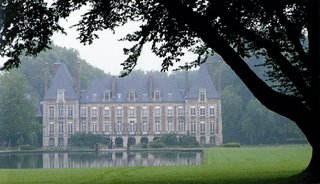
Last night we went to the INSEAD Summer Ball, held on the stunning grounds of the Chateau Courances.
My wife’s birthday was last week and I had bought a nice bottle of champagne at the legendary Vinvin wine shop in Neuilly. During the ride from Paris to the Chateau, we sipped champagne, listened to classical music and enjoyed the beautiful drive.
The chateau is jaw-droppingly beautiful, not just the slender and sophisticated building itself but the grounds around it. We strolled around for almost an hour before the party admiring the Japanese gardens, huge reflecting pools and columns of enormous trees that seem to create a cocoon of enchantment around the chateau.
I had to look twice to recognize most of my students, who had transformed themselves from t-shirts and jeans into tuxes and gowns. As much as I enjoy talking to them in class, it was even more interesting to talk to them in a social setting and find out about more about who they are and what they want to do with their lives.
We sipped champagne in the moonlight, we were dazzled by a private fireworks display across a huge reflecting pond, we danced until 2 and were then whisked back to Paris by our courteous taxi driver, who assured us that he would be working through the night ferrying people to and from the chateau. 05/28/06
One hand clapping
I finished my first (but hopefully not last) MBA class last week.
The four weeks and eight sessions went by in a blur of alternating terror and exhilaration. In keeping with the best teaching traditions, I was exactly one session ahead of the class in preparing my lessons.
Some lessons just went along on auto-pilot, reaching the end of the 90 minute session having worked through less than half of my slides. Some lessons I would look out at a sea of dazed faces about half-way through the lecture and realize that I was not even close to being prepared enough to convey what I wanted to say.
Just before I graduated from college and just after I had announced that I wanted to go into the world of business I was the subject of a family intervention. My doctor father, artist mother and caring sister sat me down and said that the cruel world of business was no place for an amiable and somewhat absent-minded computer geek.
The objective of the intervention was to channel my career interests away from the shark eat dog world of business and towards the back-stabbing but more genteel world of academia. But I, flush with the enthusiasm of seeing Steve Jobs launch the Apple Lisa with extraordinary panache, chose the macho, over-achiever world of entrepreneurship.
The class gave me a standing ovation at the conclusion of the course. I did what any macho over-achieving entrepreneur would do when faced with a situation like that. I cried. 06/05/06
France gets the important things right
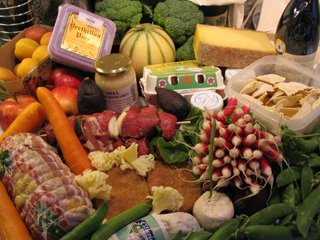
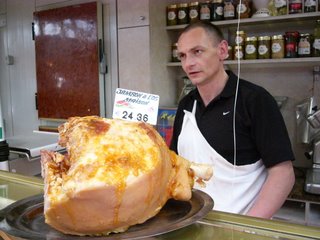
Perhaps the greatest similarity between the US and France is the ease with which they can excoriate each countries’ political situation. As easy as it is to complain about all the things wrong with French politics, they still rock at that joie de vie thing.
The best memories I will have of this year in Paris will be my weekly shopping excursions along rue de l’annonciation and prowling the aisles of the Marché Passy. When you think of all the things that have to go right to get this kind of quality food delivered to my neighborhood every week, it is clear that France still gets many important things right.
Outside of being here, there is no way to adequately convey the full experience of having the world’s best food, sold by the world’s most knowledgeable shopkeepers, simply laid at your feet each week.
On returning from my weekly shopping expedition last week, I had the inspiration to take a picture of that week’s treasures.
The picture includes a number of extraordinary items from our favorite butcher at the Marche Passy. Here you can find minor miracles like pintade farci (lower left of picture), veau milanese (the breadcrumb-covered patties) and brochette d’agneau (lamb shish kabobs). Pintade farci is a pheasant which has been de-boned, stuffed with minced and seasoned ham and wrapped with thin slices of bacon.
From the fromager we have aged goat cheese, rosettes of tête du moin (monk’s head) and incredible yogurt from Burgundy made with raw milk. Even the organic eggs blow doors on any eggs I experienced in the US – flavorful, with firm yolks and bright yellow color.
From the vegetable shop on rue de l’annonciation where the hawkers yell all day long about the freshness of their strawberries and the low, low price. Figs, apricots, melons, those incredible french radishes that you don’t get anywhere else, green beans from Kenya (which always strikes me as very exotic).
Every week the best food in the world is available mere minutes from my doorstep, whisked there through some collective magic of the French national will. Tell me that’s not getting the important things right! 06/12/06
A Tale of Two Restaurants: Le Grand Vefour and Baccarat Cristal Room
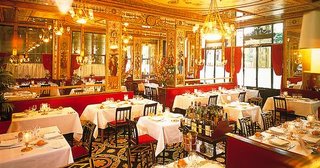
As we wind down our time in Paris, we decided to make June our blow-out culinary month. Over the last week, we had lunch at two Michelin-rated restaurants we had been eying: the Cristal Room at Bacarat (Michelin 1 star, exquisite dining, indifferent service, excruciating prices) and Le Grand Vefour (Michelin 3 star, mediocre food, great service, reasonable prices).
Today’s dining extravaganze was held at Le Grand Vefour (rated 3 stars in Michelin). This is a restaurant located in the beautiful Palais Royale, which was the playground of nobility in times gone by. Le Grand Vefour’s place in history was assured when it became the site of Napoleon and Josephine’s first date (kind of hard to imagine that – Napoleon as a shy bachelor?)
The main part of the restaurant is a small room (seats ~24 people) ornately but beautifully painted with various food & women related scenes (reflecting no doubt the two commanding passions of French men).
The great news is that service was exquisite throughout – all the waiters wore tuxedos and went out of their way to be charming and create a memorable experience. This included taking “say cheese” photos for any table that had remembered to bring a camera (we didn’t).
The not so great news is that the appetizers and entrees were distinctly mediocre, leading us to wonder what those stars were for. Having said this, it was an extraordinary dining experience, and if the food quality was well below San Francisco standards, the setting and service blew away anything the US can offer.
Wines: We started with Taittinger Rose champagne, fitting because the restaurant is owned by the same family that owns Taittinger. For the meal, we got an outstanding half bottle of Merseult ‘0 Domaine Dormat (their selection of Burgundy whites was exceptional, mostly around a 120€ price point).
Food: We took the fixed price menu, which was a reasonable 78€ each. The amuse bouche starter was the best thing we ate – mackerel three ways: fried with ginger, sushi and broiled. My appetizer was an uninspired fois gras terrine with an unidentified green sauce drizzled around it, while my wife had a more successful steamed vegetable dish.
The entrees were similarly mixed – I had a very nicely cooked cabillaud (a white snapper-like fish), while my wife had a grey and flavorless pork dish which showed signs of doing long duty under the heat lamp.
The cheese course was extraordinary. The flavor winner was a sheep’s milk blue cheese from the pyranees, followed closely by a stinky, melt-in-your-mouth epoisse.
Desert was where the restaurant suddenly roared into overdrive. My wife had a chocolate medley that must have been 2000 calories by itself, including a coffee ice cream, a to-die-for mousse au chocolate and a heart-stopping chocolate cake tart thing that still leaves me sputtering for superlatives. I had a refreshing mango/fruit medley with coconut ice cream.
But the desert crew was just getting started. While we were laboring our way through the “regular” desert, they also brought out fabulous pates de fruits, little macarons, delicious chocolate tartelettes and a kind of a strawberry drink thing. After that there was a tray of chocolates. After that, there was a bowl of caramels, noughats and home-made marshmallows.
Was the food great? No. Was the experience worth it? Yes! Lunch is definitely the way to go. Contact info: +33 (0)1 42 96 56 27, grand.vefour@wanadoo.fr, 17 rue de Beaujolais, 75001 Paris, Metro Palais Royale 06/13/06
Time to leave
My older son came home yesterday with the stomach flu. Yesterday late evening he started calling for us and we found that he had covered 75% of the available surface of his bedroom with what moments before had been the contents of his stomach.
It turns out that the overall reach of a projectile vomit is exponentially increased when launched from a height of 6 feet. This is one of those things that you don’t stop to consider when you put your children in bunk beds.
My wife asked, “how will we ever get rid of that smell?”
“Easy,” I answered, “we move back to San Francisco.”
- chris 06/22/06
Prunes to plums
After my last game of water polo in Paris, I sat drinking a beer with my friend Chuck, who was sporting a snazzy black and blue eye, courtesy of a wild shot I took during the game.
“When I first saw you last year, you were so burned out you looked like a prune, just sucked dry,” said Chuck. “Now look at you, you’re whatever a prune is before it dries out.”
“A plum?” I offered.
“Yeah, a plum.”
That, at the end of the day, is what a year in Paris did for me. Thirteen roller-coaster years in a startup – not erased, but softened. I didn’t make it all the way through my “Things I’m Gonna Do In Paris” ToDo list, but I definitely nailed the first item on the list. 07/04/06
Provence Light
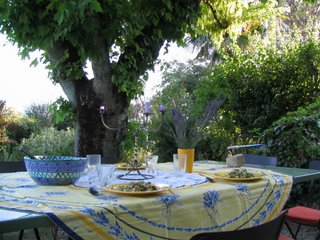
We just returned from a week in Provence followed by a week in Dardogne, the poor-man’s Provence (Provence-lite if you will).
I loved the light in Provence, that clear yellow luminance that held everything in its crystalline precision, daring you to paint it or write poetry to it or at least cook a great meal and eat it outdoors.
All activities in Provence were accompanied by the Cicadas, who I thought were saying “ne t’inquiet pas” (don’t worry) but who my more bloody-minded boys decided were saying ne tue mois (don’t kill me).
In Provence, we stayed near Beaume de Venise and drank their sweet wine (great on glass one, a bit much on glass two, undrinkable on glass three). My older son was enthralled by the local go-kart track. He has decided that his life’s calling for this month is to be a race-car driver. My younger child loved wallowing in the pool with his signature drowning water-rat stroke. My wife took advantage of her first week to contract a scary case of strep throat.
We ate out at the local public pool, whose no-name restaurant featured a different and extraordinary local specialty each day. This to me is the essence of France – that you can walk into a public pool, saunter over to the snack bar, and have an exquisite, home-cooked meal. Savoir faire impresses most where you expect it least. 07/19/06
Back in the drink
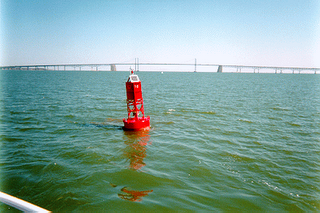
Yesterday morning was the first time I’ve been in the Bay for over a year. After a year of indoor swimming, I was finally back home, bobbing in the middle of the bay next to a buoy with the fog horns blowing and the fog so thick that Alcatraz Island was the only thing I could see.
The first week has been a whirlwind of necessity and luxury. The necessities included buying cars (a pair of Toyota hybrids), setting up cellphones and whacking the weeds away from my roses. The luxuries included carne asada burritos at La Taqueria, high tea at Lovejoy’s and a shopping expedition to Rainbow Grocery.
We had an extraordinary year in Paris, doing and seeing more than we had hoped. We found Paris to be a magical city and the French people to be charming. But at the end of the year we were ready to go home.
Going away for a year is like putting a comma in a sentence – you pause, but don’t interrupt the flow. Going away for two years is like putting a period in a sentence – when you come back, you have to start all over again.
Besides, nobody even thinks of going swimming in the Seine. 07/27/06
What I miss most about Paris
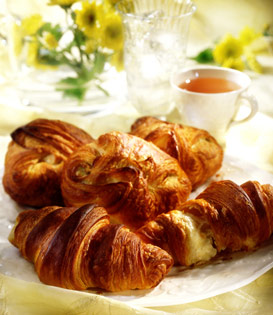
After 3 weeks in San Francisco, we are enjoying very much being back in our home, but there are of course a number of adjustments. Off the top of my head, here are three things I miss about Paris:
- Food that doesn’t smell. Every time we go to our San Francisco butcher we get home with smelly food. The French markets have both fresher products and better handling of the products in the store. In Paris, we could have the butcher prepare a chicken and cook it 3 days later. In San Francisco, the chicken smells iffy the minute you get it out of that funky plastic bag whose primary purpose seems to be preventing you from getting a fowl whiff before purchasing the bird.
- Wine with finesse. American wines are meant to be drunk much earlier than French wines, yet the grapes are the same. The reason you have to age French wines is to reduce the tannins – the bitter, pucker-producing aftertaste from a red wine. The way the American producers get around this is to make the initial taste so overpowering that you don’t notice the bitter aftertaste. The result is commonly called a fruit-bomb – a wine that clubs your tastebuds into submission so that they won’t notice they’re being bamboozled. This is also the reason that American wines don’t go well with food – the heavy, sweet fruit flavor knocks out everything in its path.
- Being exotic. In Paris, being a high tech yuppie escaped from Silicon Valley was exotic. Back in San Francisco we are just high tech yuppies whose greatest claim to fame is that we drive Toyota hybrids, not BMWs. Everyone in the Parisian ex-pat community had a story about how they got there. We also shared a sense of being outsiders and short-termers who no sane French person would befriend, so we all felt sorry for each other and go out of our way to find each other interesting. 08/15/06